
The listing sent HBAR trading volumes sharply higher, with a mid-day breakout around 12:00 UTC on July 25 pushing prices through the $0.26 mark amid more than 713 million tokens traded in a single hour. That move established the $0.26 zone as near-term resistance, though the token continued to show strong upward momentum into Saturday.
Hedera, unlike traditional blockchains, operates on a unique hashgraph consensus model that allows for high-speed, low-cost transactions at scale. It is designed to support decentralized applications, NFTs, and DeFi, and is widely known for its energy efficiency. The network’s native token, HBAR, is used to pay for network services, stake for security, and incentivize node participation.
One analyst believe HBAR could have more room to run.
On Friday, crypto analyst ChartNerd said on X that HBAR could be setting up for a major move higher — but only if it clears a key technical hurdle. Specifically, he pointed to a resistance level near $0.35, which he said aligns with something called the Supertrend indicator — a commonly used tool that helps traders identify when an asset may switch from a downtrend to an uptrend.
According to ChartNerd, if HBAR can close above that level with strong momentum, the token could enter what traders call “price discovery” — a stage where there are no prior highs to act as barriers. He cited Fibonacci extension levels, which are often used to estimate future price targets during strong uptrends, suggesting that HBAR could potentially rise to $1.26 or even $3.30 in a bullish scenario.
Technical Analysis Highlights
- According to CoinDesk Research's technical analysis data model, HBAR rose from $0.24 to $0.27 over the 24-hour period ending July 26 at 06:00 UTC, gaining nearly 12% on the day.
- The sharpest move happened around midday Friday, when a large spike in trading volume pushed prices above $0.26.
- After hitting that level, the token briefly pulled back, suggesting that $0.26 may act as a short-term ceiling.
- Support held firm around $0.24, with buying activity building steadily throughout the day and forming a clear upward trend.
- Traders are now watching for a possible move above $0.27, which could signal further gains into the weekend.
Disclaimer: Parts of this article were generated with the assistance from AI tools and reviewed by our editorial team to ensure accuracy and adherence to our standards. For more information, see CoinDesk's full AI Policy.
]]>According to Bitget Wallet CMO Jamie Elkaleh, institutional confidence has improved since Ripple’s partial legal win in March, paving the way for futures products like ProShares’ UXRP and fueling speculation around a potential spot ETF.
“XRP is regaining market momentum as renewed ETF speculation intersects with increasing legal clarity,” Elkaleh said. “This shift is boosting market depth and signaling a structural step forward for XRP’s legitimacy in U.S. markets.”
That narrative helped XRP briefly break above $3.60 before retracing to around $3.09, following $105M in long liquidations and a controversial $175M wallet transfer linked to Ripple co-founder Chris Larsen. Despite the volatility, analysts remain constructive.
“Renewed ETF speculation and legal clarity... are significant catalysts driving XRP toward the $3 mark,” said Ryan Lee, Chief Analyst at Bitget Research. “With momentum, $3.50–$4 is plausible in the coming weeks.”
XRP’s ETF exposure is currently limited to futures, but analysts say any progress toward a spot product could drive a second wave of inflows — particularly if the SEC maintains its softened posture post-March ruling.
Meanwhile, Solana is also catching a bid on the back of ecosystem growth and ETF chatter. The token now trades near $197, with analysts projecting $200–$250 as the next range if adoption trends continue.
“ETF conversations around SOL are further amplifying interest,” Elkaleh added. “With a more crypto-friendly regulatory tone emerging in the U.S., sentiment around both XRP and SOL remains constructive.”
Both assets face downside risks from macro pullbacks or renewed regulatory friction, but analysts believe fundamentals are finally starting to align with market structure. Liquidity is improving. Institutional flows are growing. And ETF products — even if only futures for now — are creating a bridge that retail and funds alike are beginning to cross.
The next move may depend less on narrative — and more on whether inflows can keep pace with expectations.
]]>The discussion between prosecutor Nathan Rehn and District Judge Katherine Polk Failla of the Southern District of New York (SDNY) came amid a break in the ongoing trial of Tornado Cash developer Roman Storm, who has been charged with conspiracy to commit money laundering, conspiracy to operate an unlicensed money transmitting business and conspiracy to violate international sanctions for his work with the privacy tool — charges for which, if found guilty, he faces up to 45 years in prison.
During their case, the prosecution introduced a slew of messages between Storm and two Dragonfly Capital partners, Schmidt and managing partner Haseeb Qureshi. In the context of the government’s case, the messages seemed to serve several purposes: to establish proper venue in New York (because Schmidt is based in Manhattan), to show that Storm and his colleagues profited from Tornado Cash and to show that they made frequent changes to the front end, or user interface, of the product.
However, when Storm’s defense team raised the possibility of asking Schmidt to testify — likely to provide context for his and Storm’s messages and to explain the firm’s rationale for investing in Tornado Cash — prosecutors declined to grant Schmidt (as well as potentially another of the defense’s would-be witnesses) immunity from his testimony being used against him in a future prosecution, prompting Schmidt to plead the fifth and decline to testify in Storm’s defense.
“Are you looking at possibly prosecuting everyone at Dragonfly?” Failla asked Rehn on Friday.
“Not everyone, but Schmidt" and another individual, Rehn said, according to Inner City Press.
The government then asked the judge to seal that portion of the transcript of the open-court discussion, which she agreed to do.
Qureshi took to X on Friday to defend his firm’s investment in Tornado Cash, writing:
“We believe deeply in Americans’ right to privacy, and the lack of it remains one of crypto’s largest unsolved problems. We therefore stand by our investment. We did not operate or exercise any control over Tornado Cash, we had no contact with any malicious users, we always encouraged our portfolio companies to follow the law, and we maintain that Tornado Cash itself has a lawful right to exist,” Qureshi wrote. “Charging a venture firm for a portfolio company’s alleged misconduct would be unprecedented, especially under these circumstances.”
Qureshi added that Dragonfly has “fully cooperated” with the government’s investigation into Tornado Cash, which he said began in 2023.
“After all of this time — years later — bringing charges against Dragonfly would be outrageous, contrary to the facts, and would induce a chilling effect onto all investment into crypto and privacy-preserving technologies in America,” Qureshi said. “We don’t believe the DOJ would actually bring such absurd and groundless charges. But if they do, we intend to vigorously defend ourselves.”
]]>The largest crypto recently changed hands at $117,200, still down 1.2% over the past 24 hours.
Some analysts noted the dip coincided with asset manager Galaxy moving large amount of BTC to exchanges overnight, likely related to the bitcoin whale that sent this month around $9 billion worth of BTC to trading desks. The wallets held BTC since the early years of Bitcoin's history, transferred the assets in after being dormant for more than a decade.
Later on Friday, Galaxy confirmed that it completed the sale of all 80,000 BTC on behalf of a client, touting it as "one of the largest notional bitcoin transactions in the history of crypto."
The sale was part of the investor's estate planning strategy, the firm said.
With the selling pressure by the whale now past, some analysts predicted the lows could be in or close.
John Glover, chief investment officer of crypto lender Ledn, said that BTC could put in a local bottom on Friday or over the weekend before continuing its push to new records, according to his Eliot wave analysis.
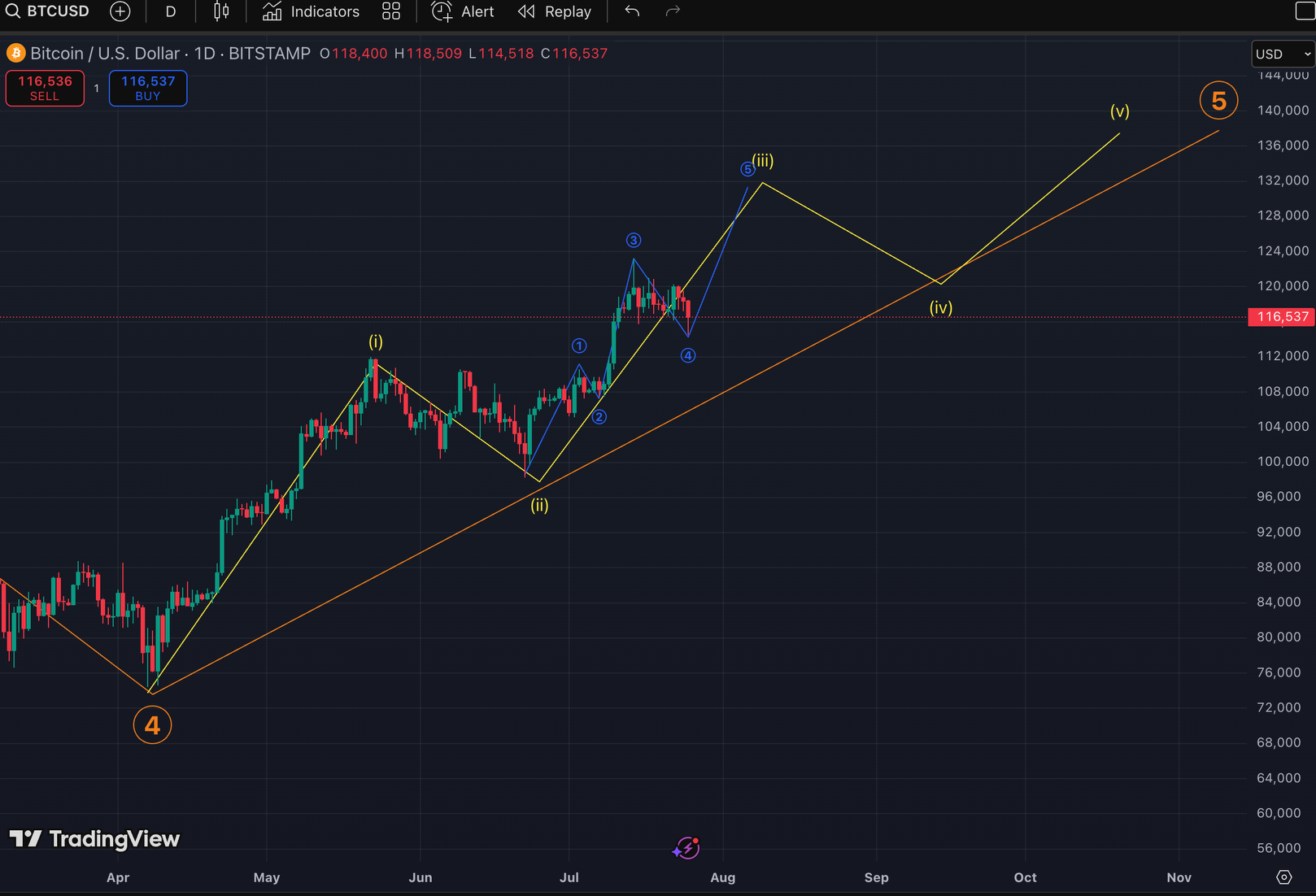
"Once completed (either today or over the weekend) I expect that we will complete wave iii by rallying to circa $132,000," Glover said in a market note.
Read more: XRP, DOGE, SOL Lead Crypto Selloff, But Altcoin Season Still in Play if This Happens
]]>XRP (XRP), dogecoin (DOGE) and Solana's SOL (SOL) declined the most among the top 10 cryptos on Friday, slipping around 5% each over the past 24 hours, CoinDesk data shows. From the Wednesday highs, XRP and DOGE plunged around 18%, while SOL was down 12% over the same stretch. The CoinDesk 80 Index, consisting of mid-cap tokens outside of the CoinDesk 20, lost 10% from the weekly peak.
Meanwhile, BTC was changing hands around $116,000, a bit more than 3% lower from its mid-week peak of $120,000. Ethereum's ether (ETH) was 4% below its weekly high, supported by steady accumulation by crypto treasury strategy firms.
When altcoin season?
The sharp sell-off of the past few days came after weeks heavy capital rotation into smaller tokens, fueling talks of a full-blown altcoin season. That period, sometimes dubbed alt season, occurs when riskier, smaller tokens outperform bitcoin, the leading crypto, for a sustained period.
CoinGlass' Alcoin Season Index, which measures the altcoin market's outperformance versus BTC on a scale of 0 to 100, cooled off to 41 on Friday from Monday's 59, the strongest reading since the late January speculative frenzy around President Trump's inauguration.
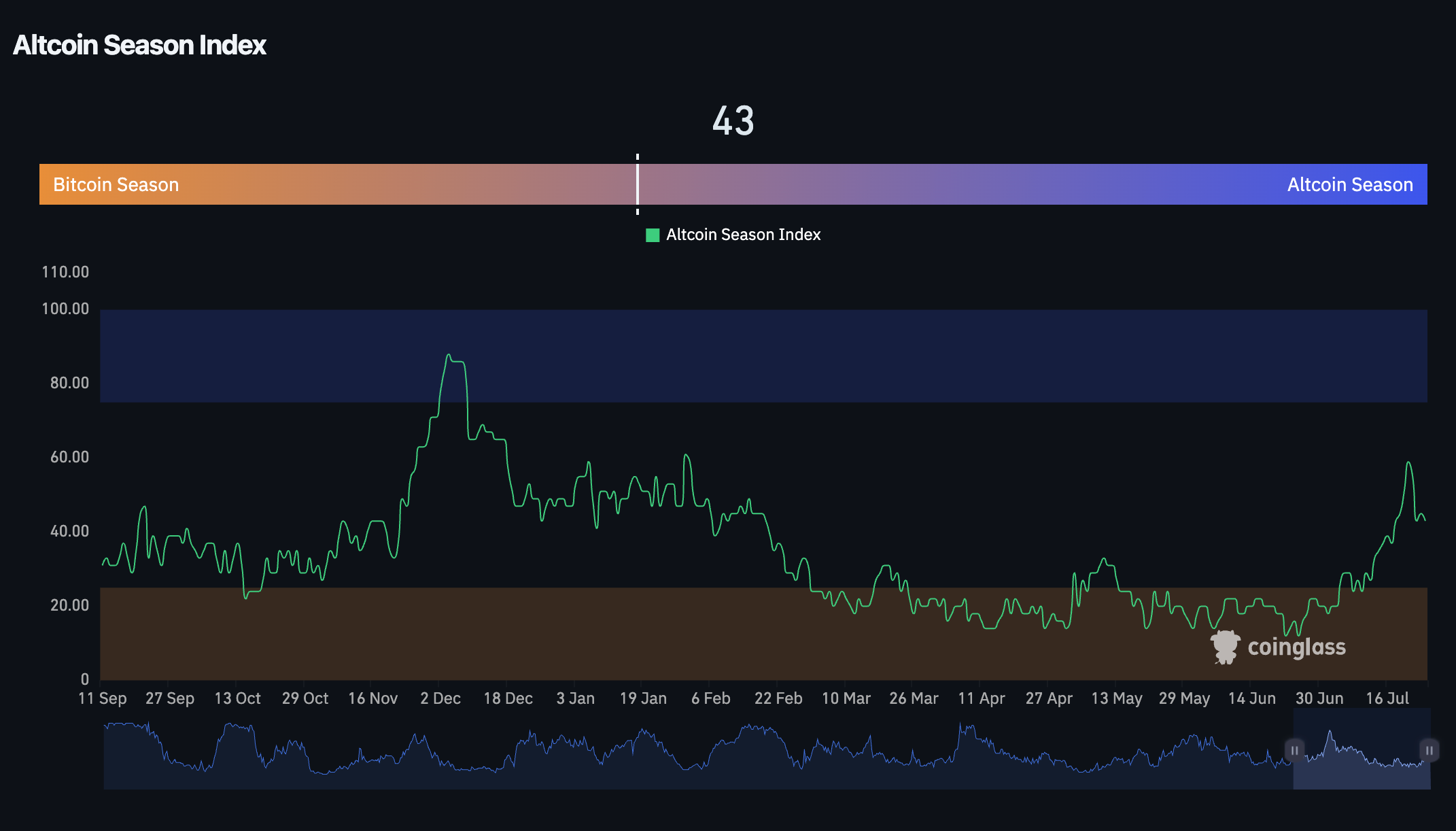
Still, the total altcoin market (except stablecoins) saw a rapid appreciation, nearly doubling in value since April, David Duong, head of research at Coinbase, said in a Friday report.
For this week's pullback, traders taking on excessive leverage on altcoin bets were to blame, the report pointed out.
The Altcoin Open-Interest Dominance metric, which compares the amount of dollars tied up in altcoin derivatives contracts to bitcoin's, soared to 1.6, a level that has preceded previous market shake-outs, the report noted. A decrease in the ratio would suggest a healthy leverage reset for the altcoin market, otherwise more shakeouts are expected, Duong wrote.
For an extended altcoin season, investors should keep an eye on the Bitcoin Dominance, which measures BTC's share of the total crypto market capitalization. The metric has broken below the 200-day moving average for the first time since a brief period in January 2025, the report noted.
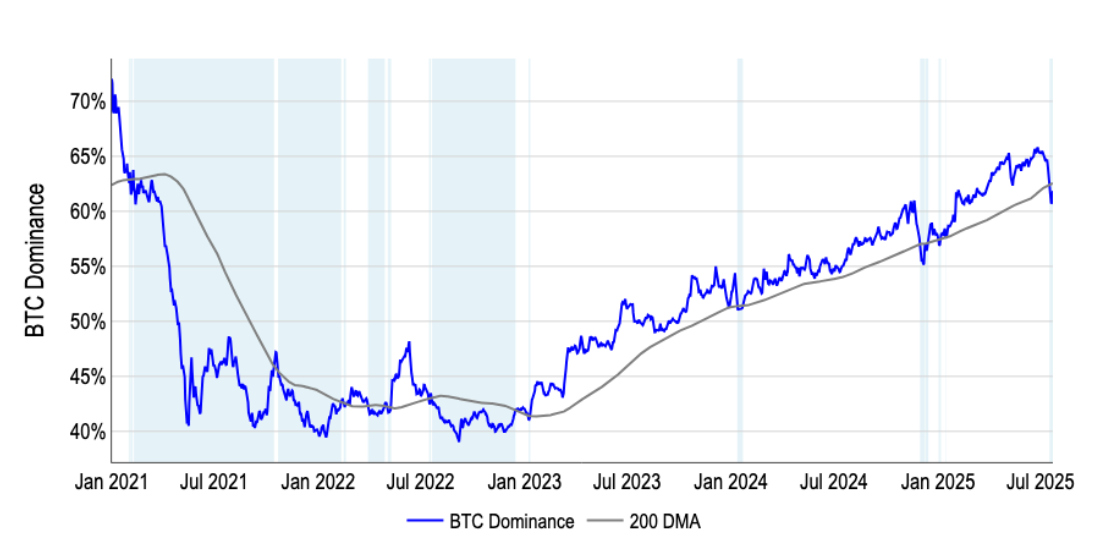
"A sustained move under the 200-DMA could validate the 'alt season' narrative and have historically preceded multi-week stretches of altcoin outperformance (like in 2021)," Duong wrote.
However, traders might be better off waiting for more consecutive sessions closing below the level before piling into altcoin bets for a more "prudent positioning," he added.
]]>The company had paused the majority of its crypto services for customers in Hungary on July 7 due to a new law that criminalized trading on unlicensed crypto platforms, but a spokesperson told CoinDesk on Friday that Revolut was comfortable bringing staking back. It had previously resumed withdrawals, the spokesperson added.
After conducting further analysis in connection with its legal position, Revolut is able to resume these [staking] services as only crypto-asset exchanges are captured by the revised legislation," a company spokesperson said in response to an emailed request for comment.
Revolut's Hungary customers are now able to participate in staking, where participants can verify transactions on the blockchain network and earn rewards on tokens via its app, and can stop staking at any time.
The company's other crypto services are still on pause, its spokesperson said, adding that new crypto deposits are currently not accepted but existing deposits in the app can be sent to another wallet.
Revolut has also been trying to comply with the Markets in Crypto Assets legislation which requires firms to get a license in at least one European Union state to be able to operate across the bloc of 27 nations. As of June 30, customers are unable to open new accounts in the Netherlands, Finland, Hungary, Latvia and Slovenia to comply with MiCA. Revolut does not yet hold a MiCA license.
]]>The model showed that substantial institutional purchasing activity developed at critical support zones around $3.87-$3.93, notably during elevated volume sessions at 03:00 and 14:00 hours.
Significant support has developed in the $3.87-$3.93 range with resistance at the $4.11 level, according to the model.
The drop in Polkadot came as the wider crypto market also fell, with the broader market gauge, the Coindesk 20, recently down 3%.
In recent trading, DOT was 1.9% lower over 24 hours, trading around $3.94.
Technical Analysis:
- Trading range of $0.24 constituting 6% differential between peak of $4.11 and trough of $3.87.
- Volume surpassed 24-hour average of 2.87 million during critical support evaluations at 03:00 and 14:00 hours.
- Robust resistance at $4.11 threshold with escalated selling momentum establishing upward movement ceiling.
- Support territory established within $3.87-$3.93 range with significant buying interest on elevated volume.
- V-shaped recovery formation emerged in final trading period with sustained rally from $3.92 minimum.
- Breakthrough above $3.94 resistance threshold suggesting potential short-term sentiment transformation.
Disclaimer: Parts of this article were generated with the assistance from AI tools and reviewed by our editorial team to ensure accuracy and adherence to our standards. For more information, see CoinDesk's full AI Policy.
]]>Ethereum’s comeback is the story of the summer. Through ETFs ($2 billion inflows in two weeks), ETH treasury vehicles and excitement around tokenization, the comeback is well and truly on. And institutions are in the driving seat.
One of BlackRock’s key digital assets stars will lead Joseph Lubin’s ETH vehicle, SharpLink.
As EY’s Paul Brody wrote this week, with institutions, “Ethereum Has Already Won,” and will probably keep winning for decades to come. The incumbency of the Network Effect – that a critical mass of transactions in stablecoins and tokenization will fall to Ethereum – makes it a de facto network.
We’ll see.
In markets:
While bitcoin held steady under 120k, altcoins did well. Hell. Most of the crypto market is looking relatively healthy these days.
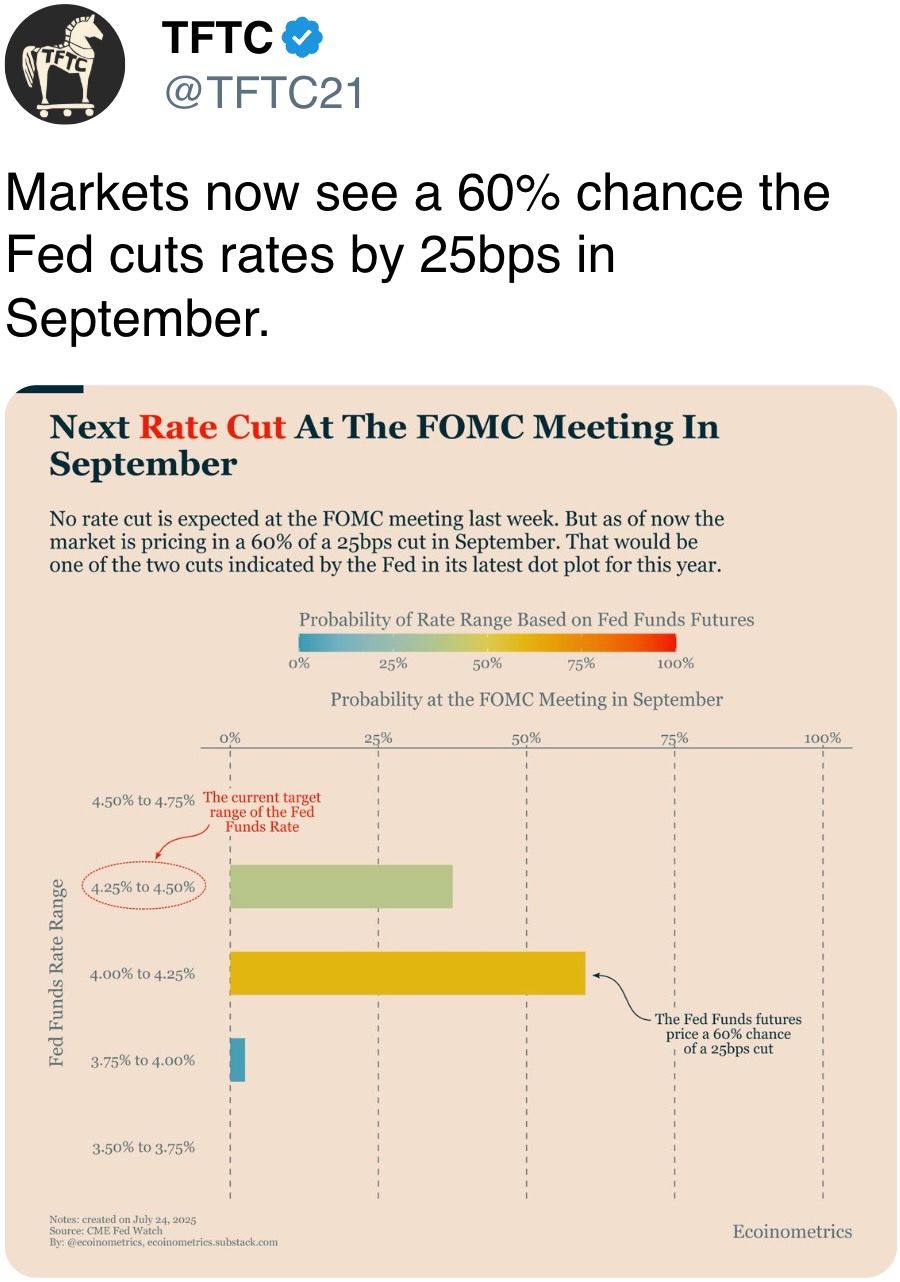
And, according to President Trump, Jerome Powell could soon cut rates (or get fired). If so, that will help risky assets like bitcoin et al.
In other big news:
Roman Storm’s Tornado Cash trial intensified. CoinDesk’s Cheyenne Ligon was there.
Elon signed up X/Grok to prediction market Kalshi
JP Morgan will offer crypto loans but faces protests from crypto trade groups over data access.
See you next week.
The Solana-based memecoin initially surged on the heels of a 500 billion token burn announcement before a Galaxy Digital-linked wallet moved $18.75 million worth of BONK to major crypto exchanges, triggering a 9% pullback in under an hour.
Despite the reversal, BONK stabilized above the $0.00003400 level with support in the $0.00003185-$0.00003230 zone, according to CoinDesk Research's technical analysis data model. Trading activity surged as speculative flows responded to conflicting signals: bullish supply reduction versus the bearish pressure of potential sell-side liquidity injections.
The broader crypto market's shift toward altcoins continued to boost meme token trading volumes as with bitcoin's market dominance weakening. BONK has benefited from increased institutional and retail attention, even as its price action remains volatile and sensitive to on-chain movements.
Technical Analysis Highlights
- BONK moved between $0.00003185 and $0.00003763, a 15% swing.
- The price dropped 9% from a peak at 15:00 UTC to $0.00003430 by 16:00 UTC.
- Strong support held at $0.00003185-$0.00003230 amid multiple overnight retests.
- From 03:00 UTC, the price rallied to $0.00003438, showing short-term stabilization.
- Between 11:10 and 12:09 UTC, BONK fell 2% to $0.00003433.
- Reduced volume during final minutes suggests declining bearish momentum.
Disclaimer: Parts of this article were generated with the assistance from AI tools and reviewed by our editorial team to ensure accuracy and adherence to our standards. For more information, see CoinDesk's full AI Policy.
]]>Chalom, who spent two decades at BlackRock in different roles, spearheaded the asset management giant's foray into digital assets and blockchain initiatives including launching the a spot ETH ETF, the press release said. He also was a board member at tokenization firm Securitize, which issues the largest tokenized U.S. Treasury fund with BlackRock.
"Few executives in the world have had the kind of impact Joseph has had in unlocking institutional adoption of digital assets, having pioneered BlackRock’s strategic entry into the space," Joseph Lubin, chairman of SharpLink, said in a statement.
SharpLink CEO Robert Pythian will transition to president over the next quarter and remain on the board.
SharpLink pivoted in May to a crypto treasury strategy focusing on Ethereum in May under the leadership of Lubin, who is the co-founder of Ethereum and CEO of Ethereum-focused development firm ConsenSys. Since then, the firm emerged as one of the most aggressive ETH buyers acquiring over $1.3 billion worth of tokens.
SBET shares are lower by 3% early Friday and down 30% over the past five sessions.
Read more: SharpLink's Ether Bet Surpasses $1.3B After Latest Purchase
]]>Spearheaded by Aaron Kirman, CEO of a Christie’s-affiliated firm in Los Angeles, the initiative follows several high-profile deals, including a $65 million Beverly Hills transaction where crypto was used exclusively.
The new division comprises legal, financial, and crypto experts to handle peer-to-peer transactions without reliance on banks. The goal is to enable high-end buyers and sellers — often seeking privacy — to use digital assets seamlessly for real-world property acquisitions.
With roughly 14% of Americans owning crypto, Kirman projects that digital currency could represent over a third of U.S. residential real estate deals within five years.
The use of crypto offers enhanced buyer anonymity, often via LLCs funded directly with digital assets, making ownership harder to trace than traditional banking channels.
Kirman’s crypto-accepting portfolio now exceeds $1 billion in value, including marquee properties like the $118M La Fin in Bel Air and Joshua Tree’s $17.95M Invisible House.
Christie's did not respond to CoinDesk's request for further
]]>That performance, while modest compared to their bitcoin counterparts, arrives alongside a surge in investor activity and price momentum. Over the past two weeks alone, the ETFs brought in more than $4.6 billion — nearly half of their total annual inflows — coinciding with a sharp uptick in ether’s (ETH) price.
ETH gained 26% during the week of July 14, after rising 16% the week before, outpacing much of the broader market. It is now trading at $3,704, up 11% on the year.
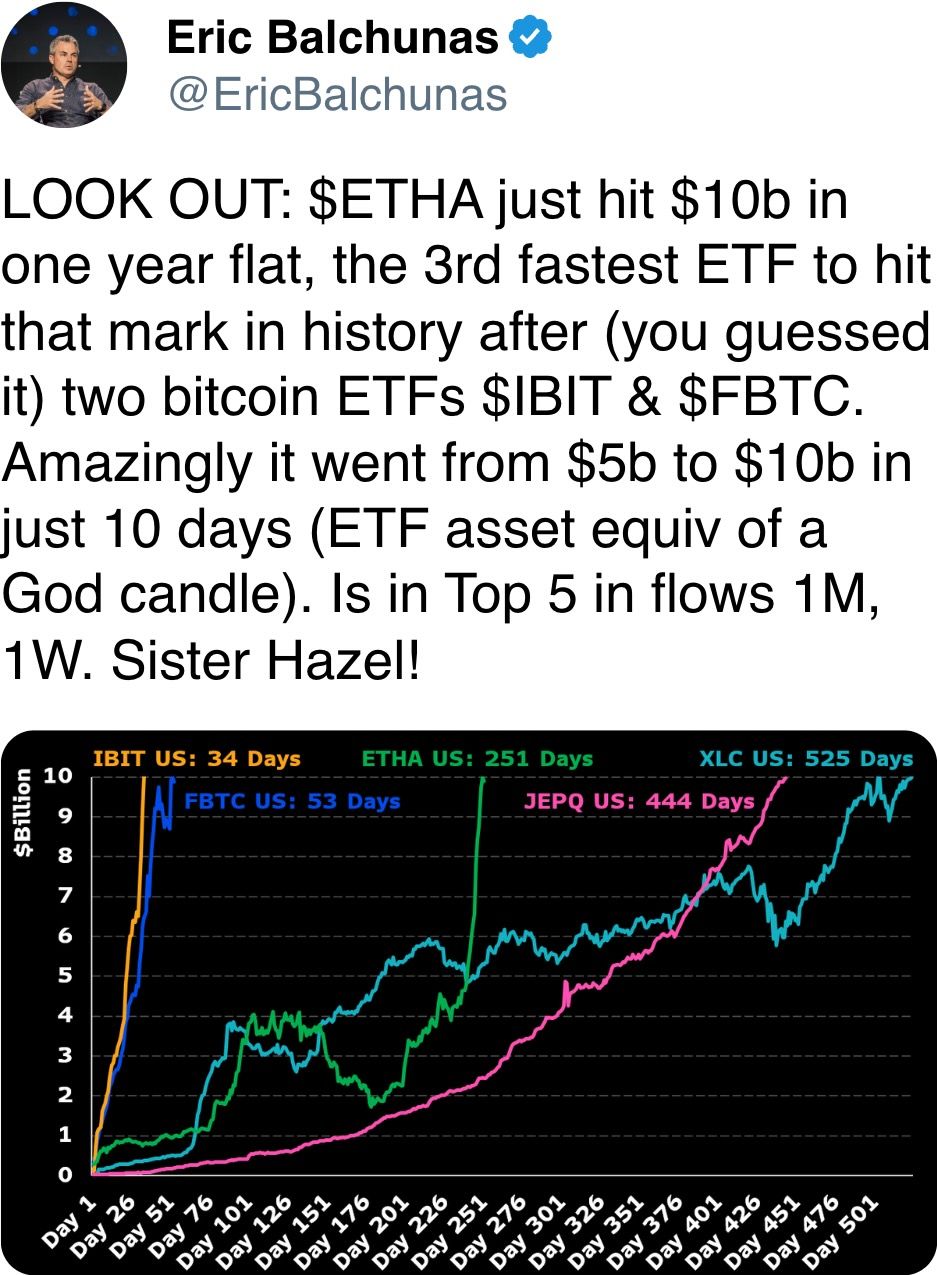
BlackRock’s iShares Ethereum Trust (ETHA) stood out among the pack by crossing $10 billion in assets under management this week. The milestone makes ETHA the third-fastest ETF in history to reach that figure, according to Bloomberg Intelligence’s Eric Balchunas. Only BlackRock’s iShares Bitcoin Trust (IBIT) and Fidelity’s Wise Origin Bitcoin Fund (FBTC) got there faster.
The spot Ethereum ETFs debuted just months after the blockbuster launch of spot bitcoin (BTC) funds, which attracted billions of dollars and renewed Wall Street’s interest in crypto-based products. The Ethereum lineup includes offerings from financial giants like Fidelity, VanEck, Franklin Templeton, Grayscale, and others.
The funds have now posted 15 straight days of net inflows, fueled by growing investor appetite and hopes for clearer crypto regulations in the U.S. The SEC has recently signaled openness to crypto legislation and industry engagement, prompting traders to rotate back into digital assets.
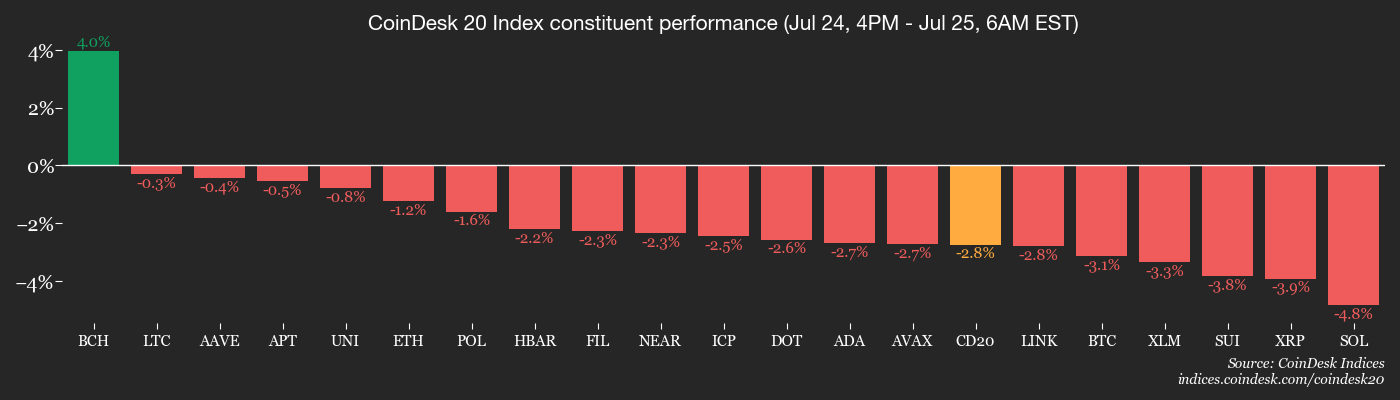
The CoinDesk 20 is currently trading at 3943.11, down 2.0% (-80.67) since 4 p.m. ET on Thursday.
Five of 20 assets are trading higher.
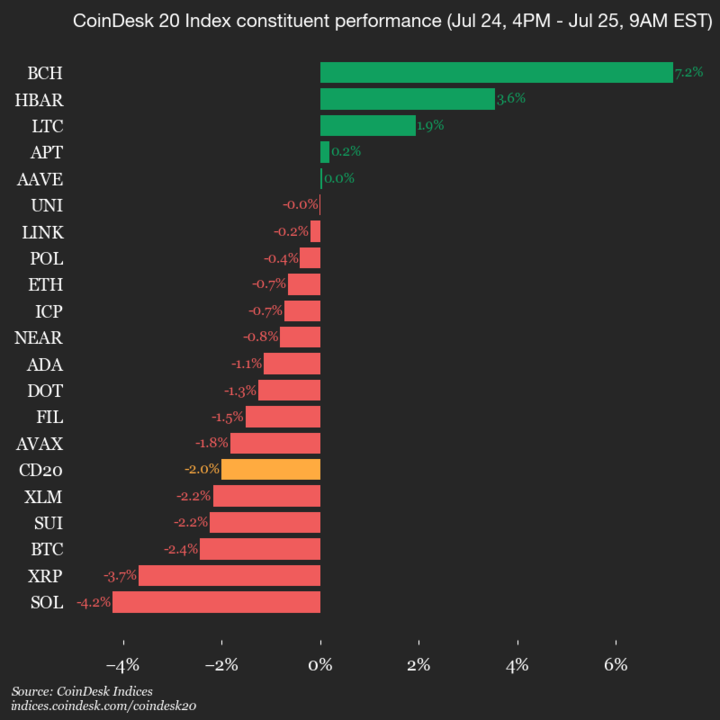
Leaders: BCH (+7.2%) and HBAR (+3.6%).
Laggards: SOL (-4.2%) and XRP (-3.7%).
The CoinDesk 20 is a broad-based index traded on multiple platforms in several regions globally.
]]>The rebound was triggered by a sharp uptick in volume, with more than 123,000 units traded after 12:01, breaking through resistance levels and signaling potential accumulation by large players. The move capped a broader 6.9% rally from $2.61 overnight support to a $2.79 close during the July 24–25 trading window, fueled by increased volatility and revived bullish sentiment.
Analysts view the surge as a potential setup for a test of the $2.83 resistance level, with longer-term projections placing NEAR in a $1.95–$9.00 range for 2025 and as high as $71.78 by 2030. Continued development of cross-chain bridging with Solana and TON is cited as a catalyst for institutional interest and potential price expansion.
Technical Breakout Signals Bullish Momentum
- $0.22 trading range represents 8.50% volatility between $2.83 maximum and $2.61 minimum during 23-hour period.
- Strong $2.61 support level confirmed with volume exceeding 3.18 million daily average.
- Recovery momentum from $2.69 to $2.79 close targets $2.83 resistance zone breakthrough.
- $2.78 consolidation precedes sharp $2.77 support test during mid-session volatility.
- Exceptional 123,000+ unit volume during final-hour surge confirms institutional accumulation phase.
- Multiple resistance levels broken during recovery establishing new $2.79 session highs.
Disclaimer: Parts of this article were generated with the assistance from AI tools and reviewed by our editorial team to ensure accuracy and adherence to our standards. For more information, see CoinDesk's full AI Policy.
]]>The purchase, carried out in rapid succession on NFT marketplace OpenSea, came after floor prices for top collections surged across the board.
Over the last 30 days, CryptoPunks jumped 29% to nearly 51 ETH (about $190,000), while Pudgy Penguins and Bored Ape Yacht Club saw 66.7% and 9.8% rises, respectively, according to CoinGecko data.
The hoodie sweep stands out because a single buyer picked up all of the rare NFTs. In total, the buyer now has 12 CryptoPunks.
Market data from CoinGecko shows that overall NFT capitalization jumped 66% to $6 billion in the past 30 days. CryptoPunks’ rally saw their share of the market grow past 30%.
Despite the rally, the NFT sector is far behind the 2021 and 2022 boom, when the market capitalization reached $16.6 billion. Since then, major marketplaces including X2Y2 have shut down and others pivoted to token trading.
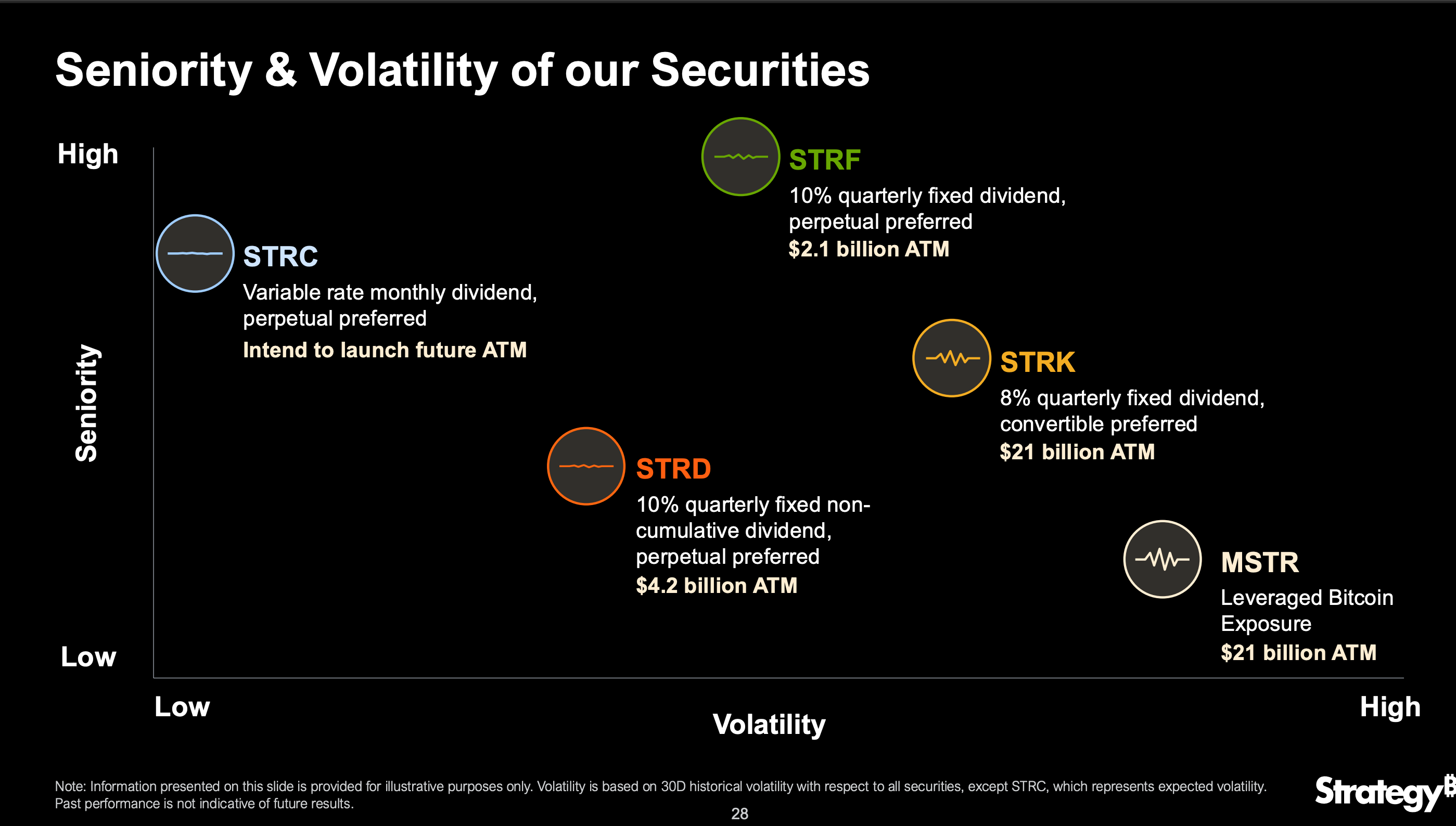
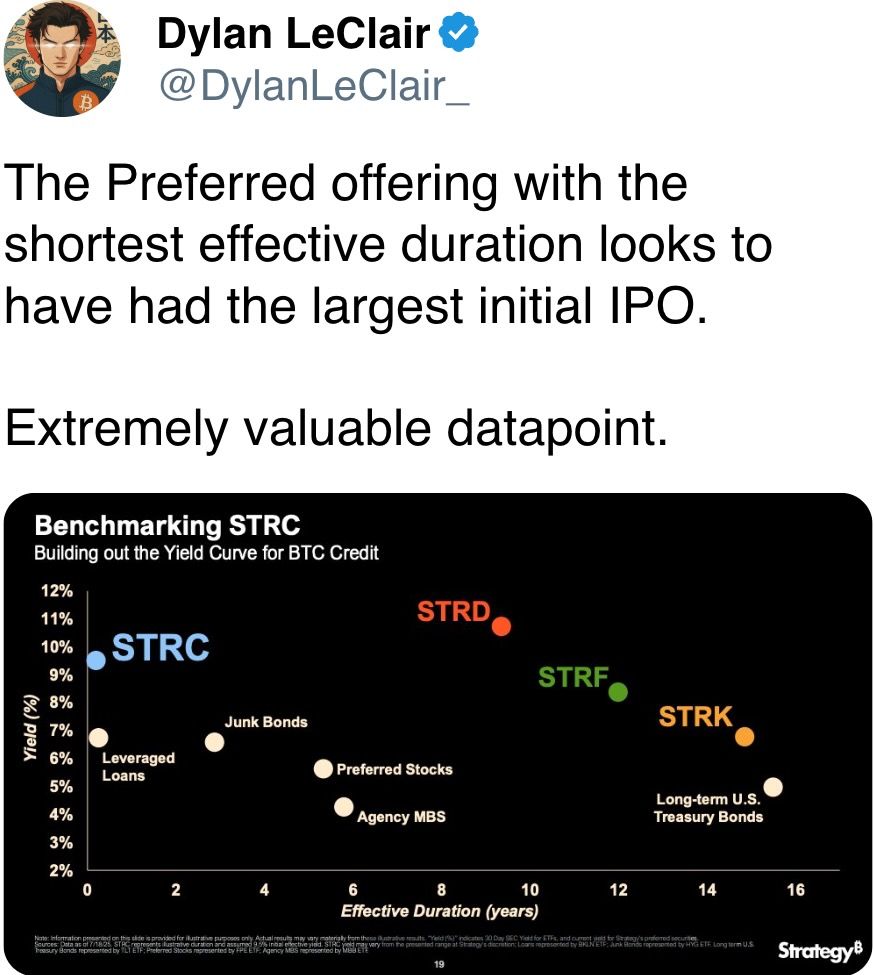
]]>Strategy (MSTR), under the leadership of Executive Chairman Michael Saylor, may have just finalized its largest preferred stock issuance to date with an upsized STRC (Stretch) offering joining the STRD, STRF and STRK preferred shares to build out the company's credit yield curve.
Among these, STRC is ranked high in seniority and low in expected volatility. It adds a new short-duration layer to Strategy’s financing mix and diversifies how the company can raise capital for BTC acquisition.
In a post on X, Saylor said the deal is 28 million shares priced at $90 each, totaling $2.50 billion. This represents a dramatic increase from the original $500 million goal announced just days earlier and underscores the company’s continued ambition to aggressively expand its bitcoin BTC holdings.
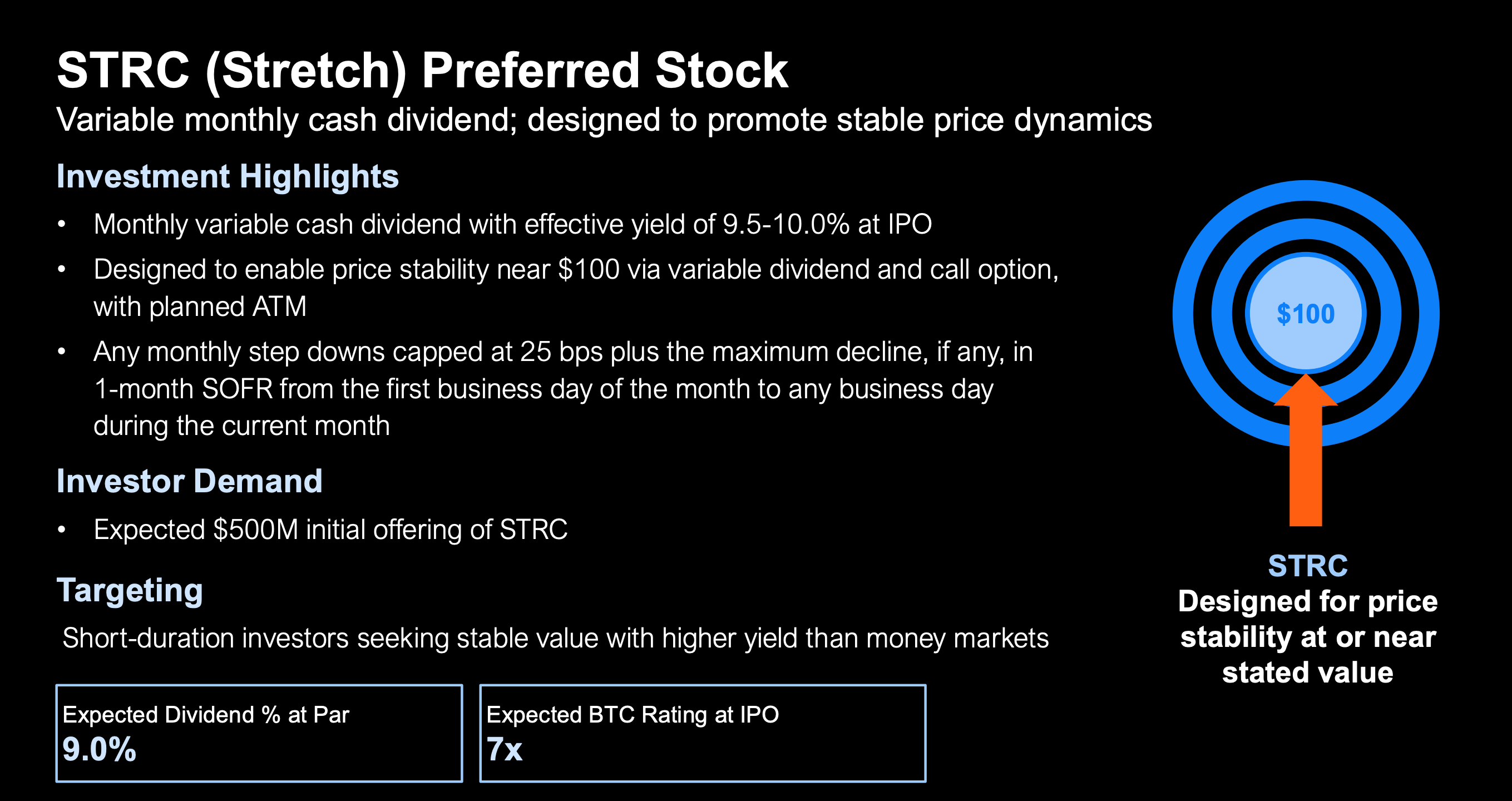
STRC is a senior, perpetual preferred stock offering a variable monthly dividend designed to appeal to yield-seeking investors who want stability near par value. At the time of the offering, STRC carried an effective yield of 9.5%–10.0% paid monthly. It contains mechanisms to maintain a trading range close to $100, including adjustable dividend rates, secondary issuance windows and call options above par.
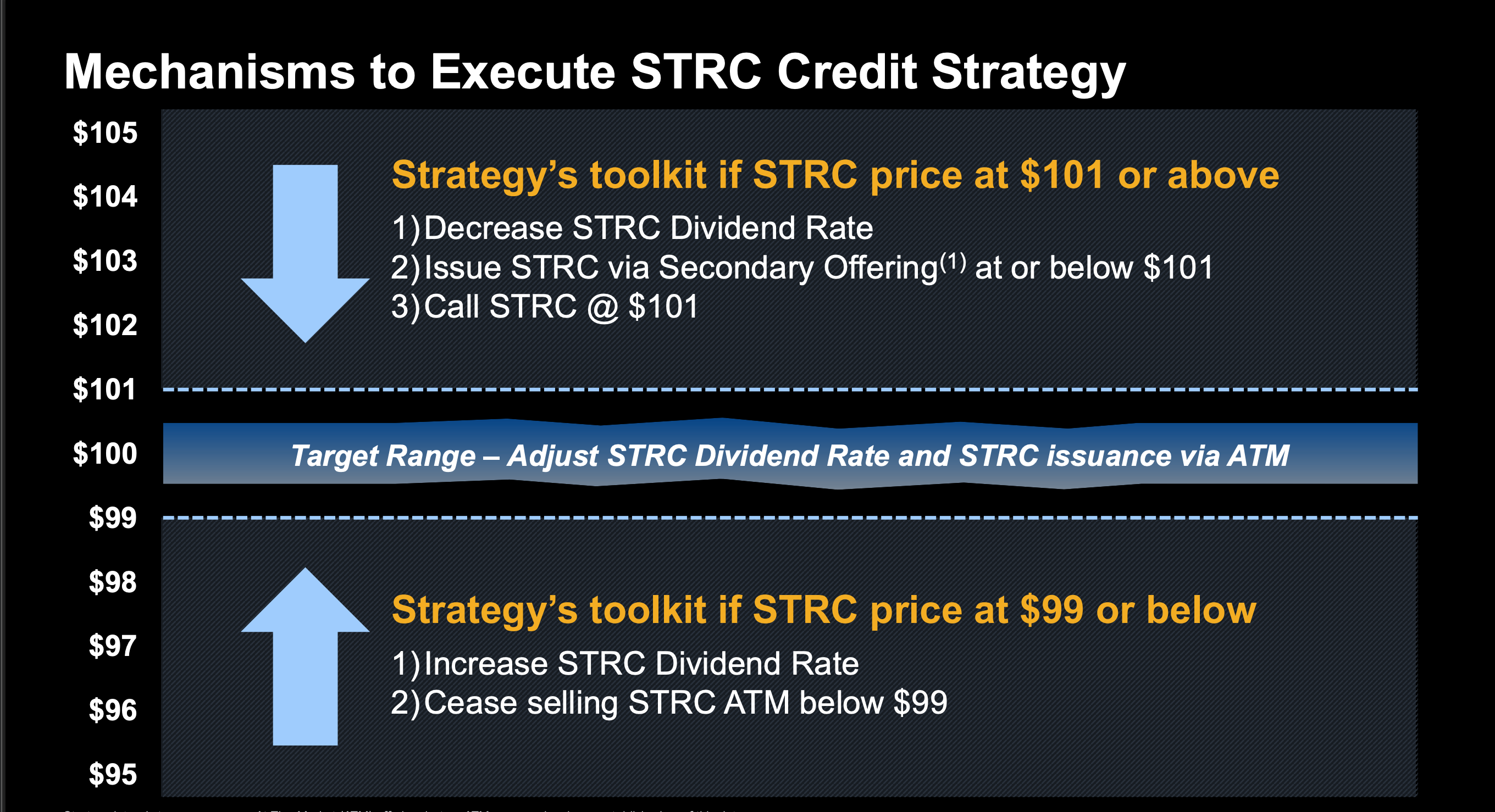
The toolkit includes raising dividends and halting sales when STRC trades below $99, or issuing new shares and calling the stock if it rises above $101. These levers are designed to create a self-correcting system that promotes market stability while offering attractive returns in the current interest-rate environment.
Any step-downs in the dividend are capped at 25 basis points plus the maximum decline in the one-month secured overnight financing rate (SOFR) over the period.
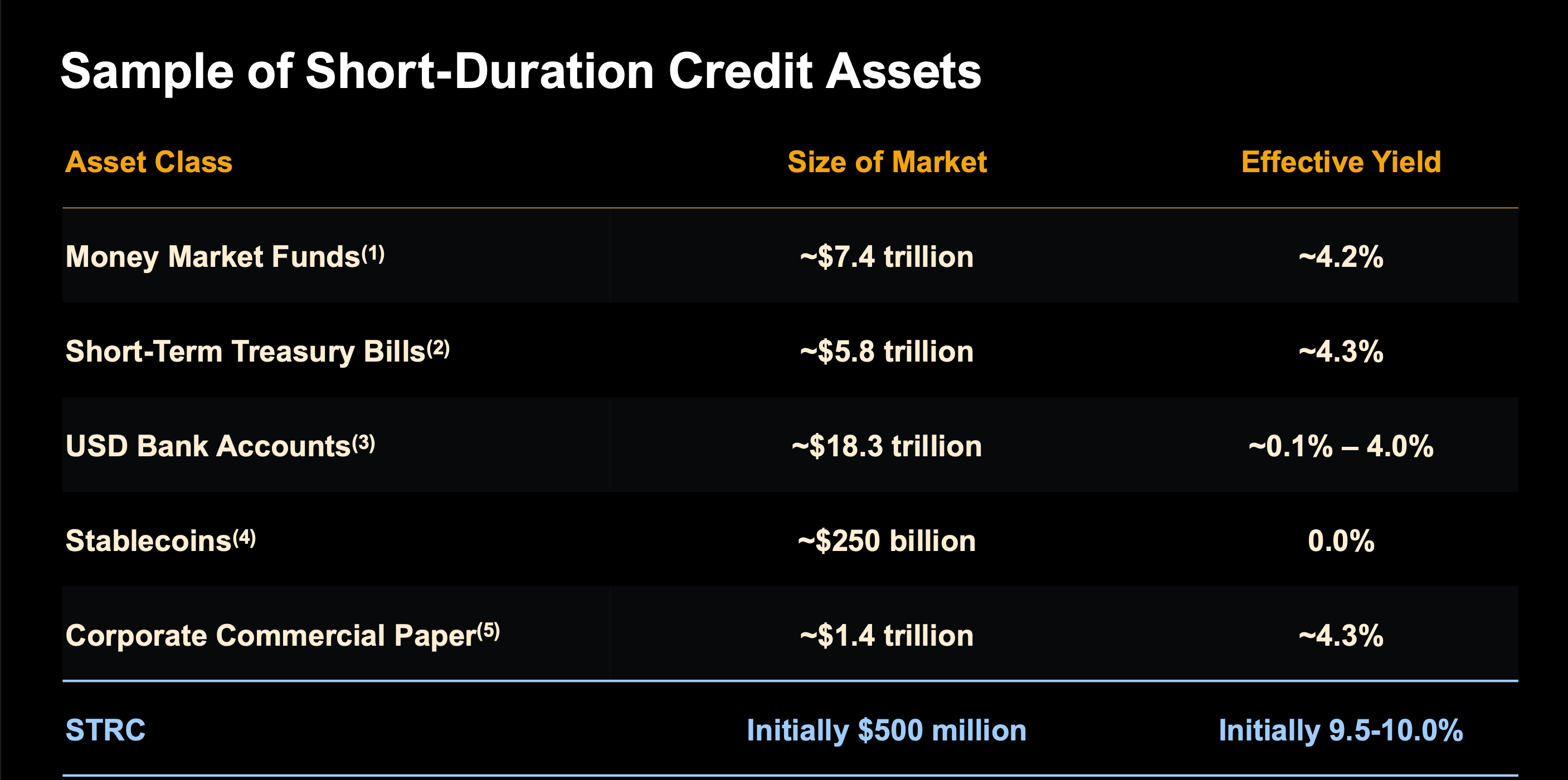
Compared with conventional short-duration credit options, STRC stands out, offering more than double the 4% available from money market funds and Treasury bills. It is targeting investors looking for higher yield without significant price volatility, positioning it competitively against traditional instruments like commercial paper and bank deposits.
UPDATE (July 25, 13:09 UTC): Replaces reported upsized deal with confirmation in third paragraph, add increased sale to headline.
]]>Such companies are attempting to replicate the model mastered by Michael Saylor's Strategy (MSTR) which has now accumulated 2.9% of all the bitcoin (BTC) that will ever exist. Since it embarked on its BTC treasury strategy in 2020, MSTR share price has increased by over 3,000%.
The bitcoin treasury strategy has been copied by a string of different companies and in recent months there has been several doing something similar with ether.
However, the possibility of this model being used with other altcoins (a general term for any cryptocurrency that isn't bitcoin) has been met with skepticism by some commentators, the Financial Times reported on Friday.
Blockchain platform Avalanche is exploring the possibility of selling a batch of its AVAX token to a publicly-listed shell company, which it would then use to earn yield and attract an investor base, according to the report, citing people familiar with the matter.
Canadian investment group RSV Capital is looking to raise $200 million of equity using a shell company that will be deployed to buy TON, the FT's reported.
This method does appear to have brought some short-term gains where it has been tried. Charlie Lee, co-founder of litecoin, invested $100 million into MEI Pharma (MEIP) for the company to buy LTC on July 18. MEIP shares jumped 17% following the announcement before falling back and are around 4.9% higher in the last week, as of writing.
However, such a business plan will not yield any long-term benefits, according to Eric Benoist, tech and data research specialist at Natixis CIB, who described it as "hugely speculative."
"That’s not going to save them for a very long time," he said. "At the end of the day they’ll be worth whatever [crypto] they have on the balance sheet and that’s it."
Geoff Kendrick, Standard Chartered's global head of digital assets, described a move into smaller altcoin treasuries as a "a flash in the pan."
He added that if the prices of the token collapsed, the companies would "have pain in either equity holder or bondholders."
]]>Bitcoin (BTC) has dropped 3% in the past 24 hours and is currently some 7% below its June 14 all-time high.
This raises the question of how much further it might drop. In the context of a continuing bull market, double-digit corrections are not unusual, with the largest drawdown reaching 30% since this cycle began in January 2023.
One technical factor to keep an eye on is the CME Bitcoin Futures gap between $114,355 and $115,670. These gaps typically occur when price movement happens outside of the CME's trading hours, generally over weekends, and they often get filled later as the price revisits those levels.
In other news, Strategy (MSTR) reportedly quadrupled the size of its Stretch (STRC) perpetual preferred stock sale. Analyst Brian Brookshire notes the offering includes 28 million STRC shares. At $90 a pop, that totals over $2.5 billion and potential demand for some 21,500 BTC given a price of $115,000.
Meantime, demand already seems to be outstripping supply, according to on-chain data from Glassnode. Since early this month, more than 210,000 BTC has been sold by long-term holders (those who've owned their BTC for longer than 155 days) and about 250,000 BTC bought by short-term holders, the data shows.
With the month-end just a week away, bitcoin is about 8% higher than at the start. That's in line with its historical trend. On average, the largest cryptocurrency has returned about 7% in July since 2013.
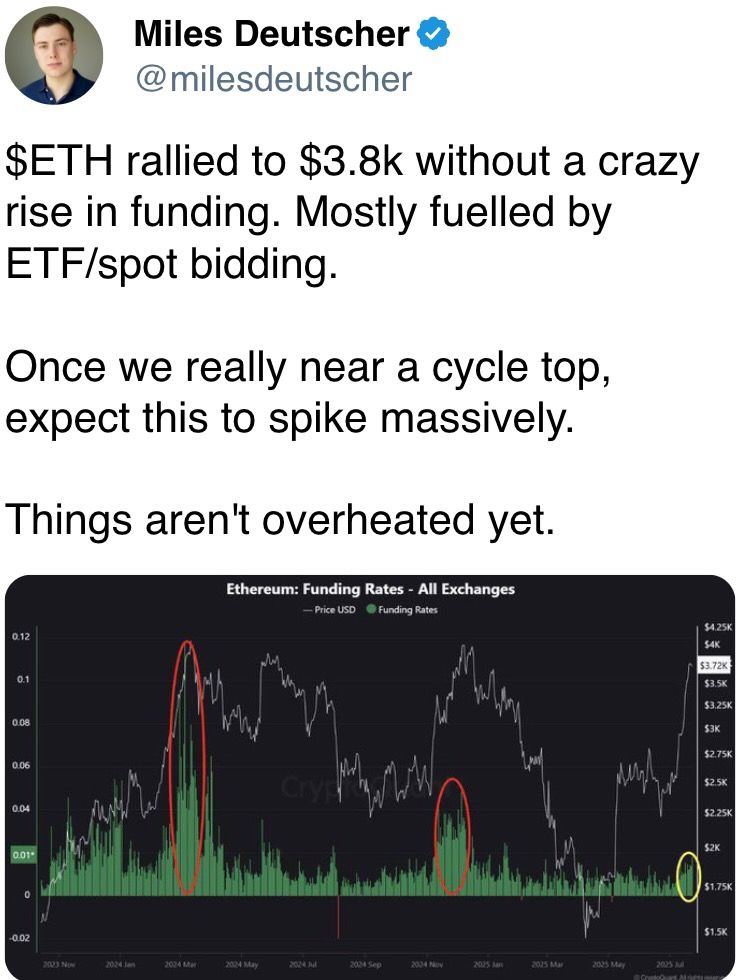
Ether (ETH), for its part, has surged over 46% and is currently trading near $3,725. This is the third time it's topped 40% since November. Interestingly, in all the other months, it fell.
August is typically quieter, which often results in lower market liquidity. Stay alert!
What to Watch
- Crypto
- July 28: Starknet (STRK), an Ethereum layer-2 validity rollup (zk-rollup), launches v0.14.0 on mainnet.
- July 31, 12 p.m.: A live webinar featuring Bitwise CIO Matt Hougan and Bitzenship founder Aleesandro Palombo discussing bitcoin’s potential as the next global reserve currency amid de-dollarization trends. Registration link.
- Aug. 1: The Helium Network (HNT), now running on Solana, undergoes its halving event, cutting annual new token issuance to 7.5 million HNT.
- Aug. 1: Hong Kong’s Stablecoins Ordinance takes effect, introducing a licensing regime to regulate stablecoin activities in the city.
- Aug. 15: Record date for the next FTX distribution to holders of allowed Class 5 Customer Entitlement, Class 6 General Unsecured and Convenience Claims who meet pre-distribution requirements.
- Macro
- July 25, 8:30 a.m.: The U.S. Census Bureau releases June manufactured durable goods orders data.
- Durable Goods Orders MoM Est. -10.8% vs. Prev. 16.4%
- Durable Goods Orders Ex Defense MoM Prev. 15.5%
- Durable Goods Orders Ex Transportation MoM Est. 0.1% vs. Prev. 0.5%
- July 28, 8 a.m.: Mexico's National Institute of Statistics and Geography releases June unemployment rate data.
- Aug. 1, 12:01 a.m.: New U.S. tariffs take effect on imports from trading partners that failed to reach agreements by the July 9 deadline. These increased duties could range from 10% to as high as 70%, impacting a wide range of goods.
- July 25, 8:30 a.m.: The U.S. Census Bureau releases June manufactured durable goods orders data.
- Earnings (Estimates based on FactSet data)
- July 29: PayPal Holdings (PYPL), pre-market, $1.30
- July 30: Robinhood Markets (HOOD), post-market, $0.31
- July 31: Coinbase Global (COIN), post-market, $1.39
- July 31: Reddit (RDDT), post-market, $0.19
- July 31: Sequans Communications (SQNS), pre-market
- Aug. 5: Galaxy Digital (GLXY), pre-market, $0.19
- Aug. 7: Block (XYZ), post-market, $0.67
- Aug. 7: Coincheck Group (CNCK), post-market
- Aug. 7: Hut 8 (HUT), pre-market, -$0.08
- Aug. 27: NVIDIA (NVDA), post-market, $1.00
Token Events
- Governance votes & calls
- Aavegotchi DAO is voting on a proposal to sell its treasury of around 16 million GHST for around 3.2 million USDC to VC firm Rongming Investment , dissolve the DAO and distribute funds to active members. The VC firm aims to scale Aavegotchi globally while Pixelcraft retains IP ownership. Voting ends July 25.
- Lido DAO is voting on a new system that lets validator exits be triggered automatically through the execution layer, not just by node operators. It includes tools for different authorization pathways, emergency controls, and built‑in limits to prevent misuse. The update is expected to make staking more decentralized, more secure and more responsive. Voting ends July 28.
- GnosisDAO is voting on a proposal to provide $30 million a year, paid quarterly, to Gnosis Ltd., now a non-profit, to sustain its 150‑person team building critical Gnosis Chain infrastructure, products (like Gnosis Pay and Circles), business development and operations. Voting ends July 28.
- Aavegotchi DAO is voting on funding three new features for the official decentralized application: a Wearable Lendings UI, Gotchis Batch Lending and a BRS Optimizer. Voting ends July 29.
- NEAR Protocol is voting on potentially reducing NEAR’s inflation from 5% to 2.5%. Two-thirds of validators must approval the proposal for it to pass, and if so it could be implemented by late Q3. Voting ends Aug. 1.
- July 25: MEXC, Ethena and TON to host an X Spaces session on “Stablecoin for You & Me.”
- July 29, 10 a.m.: Ether.fi to host a bi-quarterly analyst call.
- Unlocks
- July 28: Jupiter (JUP) to unlock 1.78% of its circulating supply worth $28.77 million.
- July 31: Optimism (OP) to unlock 1.79% of its circulating supply worth $22.08 million.
- Aug. 1: Sui (SUI) to unlock 1.27% of its circulating supply worth $162.78 million.
- Aug. 2: Ethena (ENA) to unlock 0.64% of its circulating supply worth $22.29 million.
- Aug. 9: Immutable (IMX) to unlock 1.3% of its circulating supply worth $13.38 million.
- Aug. 12: Aptos (APT) to unlock 1.73% of its circulating supply worth $53.27 million.
- Token Launches
- July 25: 5ireChain (5IRE), Aperture Finance (APTR), Ertha (ERTHA), Gummy (GUMMY), Pip (PIP), and Teleport System Token (TST) to be delisted from Bybit.
Conferences
The CoinDesk Policy & Regulation conference (formerly known as State of Crypto) is a one-day boutique event held in Washington on Sept. 10 that allows general counsels, compliance officers and regulatory executives to meet with public officials responsible for crypto legislation and regulatory oversight. Space is limited. Use code CDB10 for 10% off your registration through Aug. 31.
- July 25: Blockchain Summit Global (Montevideo, Uruguay)
- July 28-29: TWS Conference 2025 (Singapore)
- Aug. 6-7: Blockchain.Rio 2025 (Rio de Janeiro, Brazil)
- Aug. 6-10: Rare EVO (Las Vegas)
- Aug. 7-8: bitcoin++ (Riga, Latvia)
- Aug. 9-10: Baltic Honeybadger 2025 (Riga, Latvia)
- Aug. 9-10: Conviction 2025 (Ho Chi Minh City, Vietnam)
Token Talk
By Shaurya Malwa
- WWE legend Hulk Hogan died Thursday following a cardiac arrest, triggering a wave of tribute posts for the wrestler and a near-instant surge of branded memecoins on Ethereum and Solana.
- The newly launched Wrapped ETH token “Hulkamania (HULK)” pumped over 122,000% within hours of deployment, peaking at $0.001335 and briefly hitting a seven-figure market cap, according to DEXTools.
- On Solana, a memecoin named HULKAMANIA (HULK) — launched in June 2024 — surged over 2,000% in 24 hours, trading near $0.0006146 with a revived market cap of $500,000.
- Despite the rally, the Solana-based HULK is still far below its $18.8 million all-time high from last year, which followed a now-deleted promotional tweet from Hogan’s official X account.
- Hogan, at the time, claimed the post wasn’t made by him.
- None of the current HULK tokens are officially affiliated with Hogan’s estate or brand and multiple copycat versions have already vanished from the DEX landscape, suggesting they are likely rug pulls and honeypots.
- Hogan joins a growing list of celebrities whose posthumous memecoins see rapid speculative inflows, often fueled by nostalgia, shock and social media virality before liquidity drains as fast as it arrives.
- It's worth remembering that tribute memecoins offer no legitimacy, no roadmap and no protections despite often being the fastest-moving tokens on DEX platforms during news-driven spikes.
Derivatives Positioning
- Open interest (OI) for bitcoin across top derivatives venues remains at all time highs.
- According to Velo, OI currently sits at $34.1 billion. Binance still leads with $14.2 billion open interest followed by Bybit at $9.5 billion.
- Three-month annualized basis for BTC is at 6.3%, dropping off from 9% earlier in the week.
- In terms of perpetual volumes, ETH volumes currently exceed BTC volumes at 140.6 billion versus 121.4 billion respectively, as per Coinglass.
- Bitcoin put-call volume currently stands at 44,600 contracts, with calls accounting for 52% of the total, according to Velo. Options OI for bitcoin is just under all time highs at $83.5 billion, according to Coinglass.
- Ether, on the other hand, currently has 196,400 put-call contract volume with 54% being calls. Open interest is currently at $9.6 billion, below the March 2024 all-time high of $14.8 billion.
- Funding rate APRs for BTC are muted across most venues except Hyperliquid, where the rate currently is at 90% annualized funding. This is well above altcoins such as SOL and HYPE, which currently show an annualized funding of 10% and 32%, respectively, as per Coinglass.
Market Movements
- BTC is down 2.39% from 4 p.m. ET Thursday at $115,912.54 (24hrs: -1.99%)
- ETH is down 0.41% at $3,721.30 (24hrs: +2.54%)
- CoinDesk 20 is down 1.94% at 3,940.10 (24hrs: +0.64%)
- Ether CESR Composite Staking Rate is up 1 bp at 2.96%
- BTC funding rate is at 0.0367% (40.1865% annualized) on KuCoin
- DXY is up 0.32% at 97.68
- Gold futures are down 0.72% at $3,349.30
- Silver futures are down 0.34% at $39.09
- Nikkei 225 closed down 0.88% at 41,456.23
- Hang Seng closed down 1.09% at 25,388.35
- FTSE is down 0.29% at 9,112.22
- Euro Stoxx 50 is down 0.15% at 5,347.34
- DJIA closed on Thursday down 0.70% at 44,693.91
- S&P 500 closed unchanged at 6,363.35
- Nasdaq Composite closed up 0.18% at 21,057.96
- S&P/TSX Composite closed down 0.16% at 27,372.26
- S&P 40 Latin America closed down 0.44% at 2,627.58
- U.S. 10-Year Treasury rate is up 1.2 bps at 4.42%
- E-mini S&P 500 futures are unchanged at 6,407.00
- E-mini Nasdaq-100 futures are unchanged at 23,374.00
- E-mini Dow Jones Industrial Average Index are up 0.13% at 44,956.00
Bitcoin Stats
- BTC Dominance: 61.46% (-0.58%)
- Ether-bitcoin ratio: 0.03184 (1.65%)
- Hashrate (seven-day moving average): 914 EH/s
- Hashprice (spot): $59.04
- Total fees: 9.82 BTC / $1,166,840
- CME Futures Open Interest: 147,320 BTC
- BTC priced in gold: 34.4 oz.
- BTC vs gold market cap: 9.66%
Technical Analysis
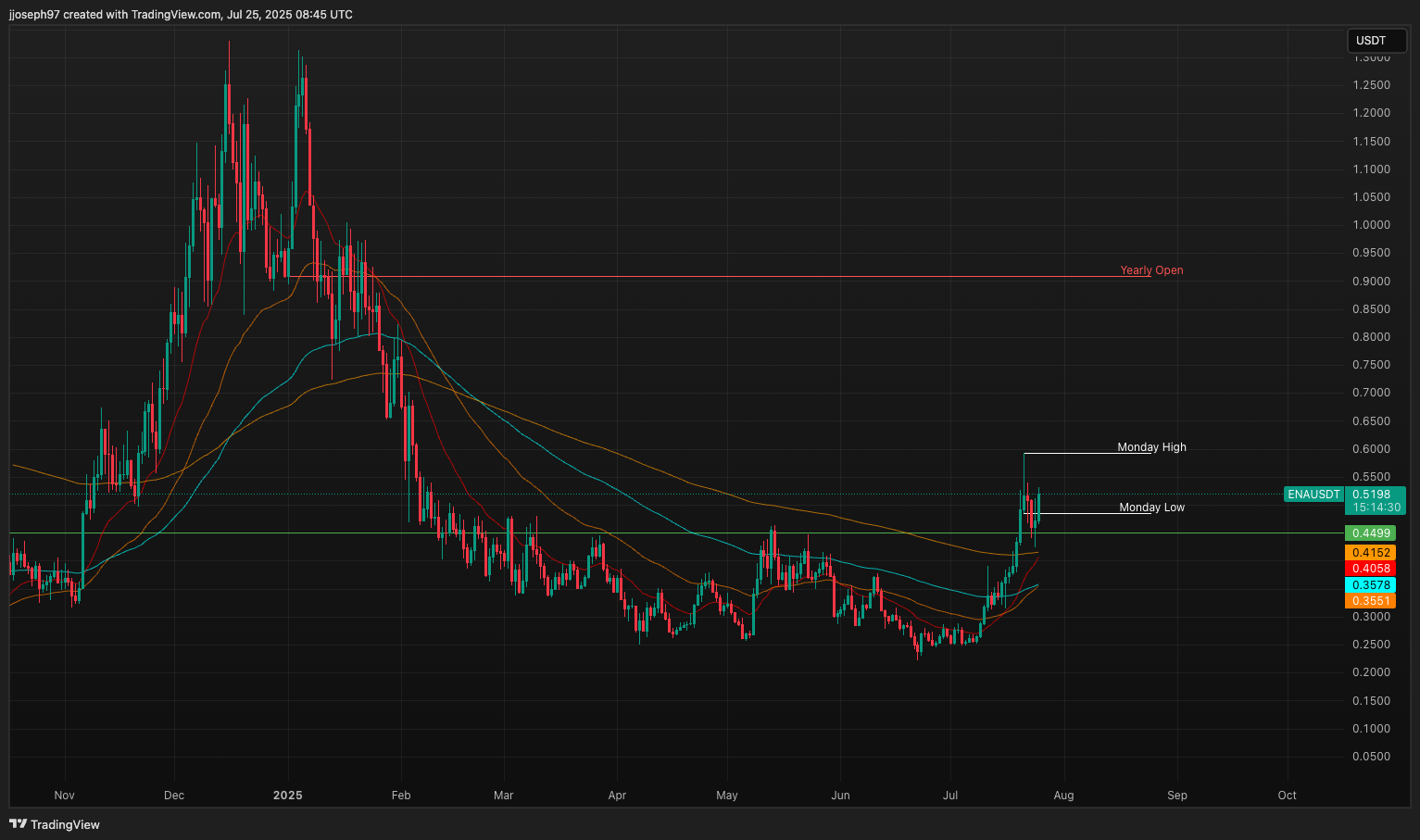
- Ethena's ENA has been one of the strongest performers in the market, following the announcement of StablecoinX, a SPAC that has raised $360 million to acquire ENA as treasury holdings.
- On the daily timeframe, ENA has broken its downtrend and retested the previous resistance at $0.45.
- This bullish narrative is further supported by the confluence of reclaiming Monday’s low and the 50-day exponential moving average on the weekly chart.
Crypto Equities
- Strategy (MSTR): closed on Thursday at $414.92 (+0.55%), -2.44% at $404.79 in pre-market
- Coinbase Global (COIN): closed at $396.7 (-0.28%), -1.75% at $389.74
- Circle (CRCL): closed at $193.08 (-4.61%), -0.64% at $191.84
- Galaxy Digital (GLXY): closed at $31.89 (+2.77%), -4.2% at $30.55
- MARA Holdings (MARA): closed at $17.26 (-1.76%), -2.95% at $16.75
- Riot Platforms (RIOT): closed at $14.69 (+2.44%), -2.59% at $14.31
- Core Scientific (CORZ): closed at $13.69 (+1.48%), unchanged in pre-market
- CleanSpark (CLSK): closed at $12.34 (-0.88%), -2.35% at $12.05
- CoinShares Valkyrie Bitcoin Miners ETF (WGMI): closed at $27.11 (-0.84%)
- Semler Scientific (SMLR): closed at $38.89 (-1.09%), -3.57% at $37.5
- Exodus Movement (EXOD): closed at $33.61 (-1.75%), +3.01% at $34.62
- SharpLink Gaming (SBET): closed at $23.32 (-9.65%), +2.44% at $23.89
ETF Flows
Spot BTC ETFs
- Daily net flows: $226.7 million
- Cumulative net flows: $54.67 billion
- Total BTC holdings ~1.29 million
Spot ETH ETFs
- Daily net flows: $231.2 million
- Cumulative net flows: $8.9 billion
- Total ETH holdings ~5.34 million
Source: Farside Investors
Overnight Flows
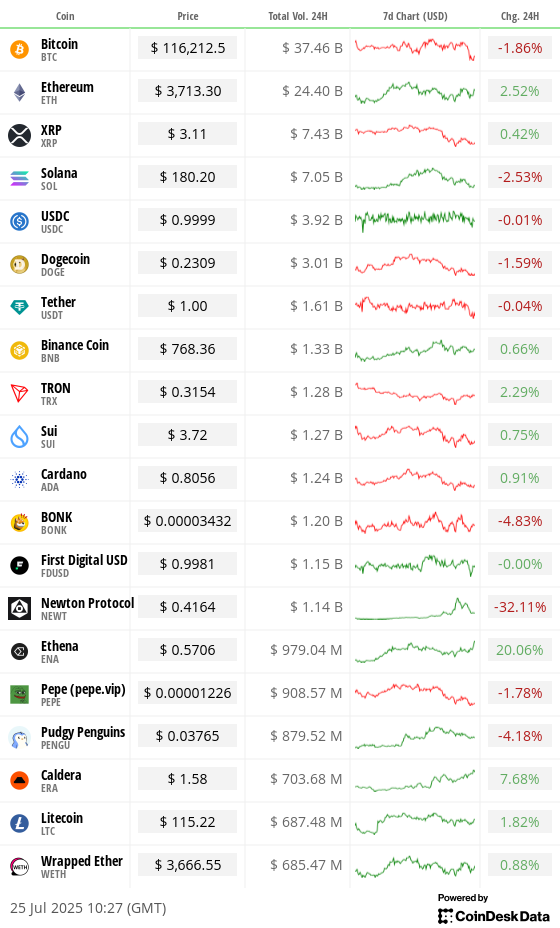
Chart of the Day
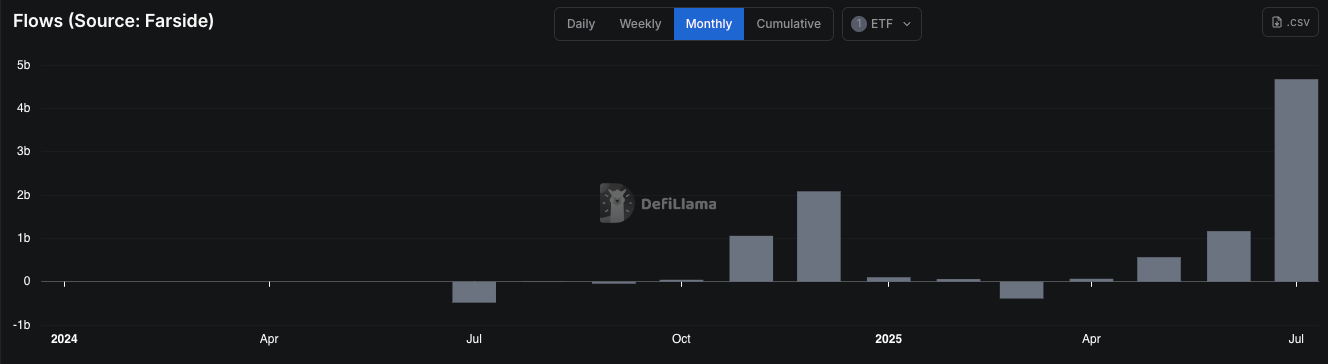
- Spot ether ETFs in the U.S. have recorded $4.67 billion in net inflows in July alone, surpassing the total cumulative net inflows of $4.23 billion accumulated from inception through June.
While You Were Sleeping
- Trump’s Tariffs Are Being Picked Up by Corporate America (The Wall Street Journal): American companies are largely delaying price hikes and absorbing tariff costs for now as foreign sellers offer limited relief and President Trump’s trade deals add uncertainty over who ultimately pays.
- Iran Starts New Talks Today Over Its Nuclear Program. Here’s What to Know. (The New York Times): European officials resumed talks with Iran in Istanbul, warning they’ll restore suspended U.N. sanctions by the end of next month if Tehran doesn’t reengage with the U.S. and curb uranium enrichment.
- Bitcoin to Hit $135K by Year-End in Base-Case Forecast, $199K in Bullish Scenario: Citi (CoinDesk): In the bank's most bearish setup, the forecast drops to $64,000.
- Companies Load Up on Niche Crypto Tokens to Boost Share Prices (Financial Times): Some public companies are turning to altcoin treasuries to differentiate and boost valuation. Analysts say this speculative trend offers no long-term solution for firms already facing financial distress.
- Volmex's Bitcoin and Ether Volatility Futures Top $10M Volume Since Debut as Traders Look Beyond Price (CoinDesk): Traders are using these recently launched products on the decentralized platform to express views on market turbulence without taking a directional stance on BTC/ETH prices or managing complex option strategies.
- Digital Assets Firm OSL Raises $300 Million to Expand Crypto Business Worldwide (Bloomberg): As Hong Kong awaits its stablecoin law taking effect Aug. 1, the CFO of one of its earliest licensed exchanges says the new funding will support a broader push into overseas digital asset markets.
In the Ether
 ]]>
]]>
Daily volume increased from $230 million to $862 million after the listing as traders poured in to buy SYRUP despite a wider crypto market pullback.
BTC retreated back to $116,000 on Monday as assets like SOL also failed to impress, sliding another 2% to $180 to erode the previous four days of gains.
SYRUP is also well poised for continuation to the upside in light of governance proposal MIP-018, which suggests increasing token buybacks using protocol revenue. Voting began on July 25.
From a technical perspective, SYRUP is in clear breakout territory with the move being backed by significant volume and momentum. It spiked to momentarily form a new record high on Friday, touching 68 cents before retreating back to 59 cents.
Read more: Bitcoin Slides to $115K as Dow Jones' Rally Stalls at December-January High
]]>The model showed that the period was highlighted by an explosive intraday rally at 14:00 on July 24, with price action accelerating from $4.59 to $4.75 accompanied by substantial volume of 3.64 million, creating robust volume-confirmed support at the $4.59 threshold.
Post-breakout, APT sustained consistent trading above the $4.60 level, encountering significant resistance in the $4.75-$4.79 range, according to the model.
The recent altcoin correction eliminated $960 million in leveraged positions throughout the cryptocurrency ecosystem.
The bounce in Aptos came as the wider crypto market fell, with the broader market gauge, the Coindesk 20, recently down 0.6%.
In recent trading, APT was 1.2% higher over 24 hours, trading around $4.695.
Technical Analysis:
- The trading session included a significant retracement to $4.62 approximately at 07:53, forming a crucial support foundation before launching a sustained upward movement.
- Price action reached $4.67 near 08:06, illustrating substantial buying pressure and momentum alignment.
- The recovery sequence confirms the previously established support territory around $4.58-$4.60.
- APT effectively maintained ascending lows, indicating potential advancement toward the identified resistance zone near $4.75-$4.79.
Disclaimer: Parts of this article were generated with the assistance from AI tools and reviewed by our editorial team to ensure accuracy and adherence to our standards. For more information, see CoinDesk's full AI Policy.
]]>In the bank's most optimistic scenario, the largest cryptocurrency could climb to $199,000 by the end of the year, while a more bearish outlook, shaped largely by weak equities, pulls the forecast down to $64,000.
The updated outlook incorporates a trio of key drivers: user adoption, macroeconomic conditions and demand from spot exchange-traded funds (ETFs), the bank said in a report Thursday.
The core of Citi’s approach begins with an adoption model based on user activity. The bank's analysts projected a 20% increase in user growth, along with linear network effects. On its own that would support a price of roughly $75,000.
From there, macroeconomic factors subtract about $3,200, led by soft equity and gold performance, while an assumed $15 billion in additional ETF flows add around $63,000 to the forecast. The result: A base-case year-end target of $135,000.
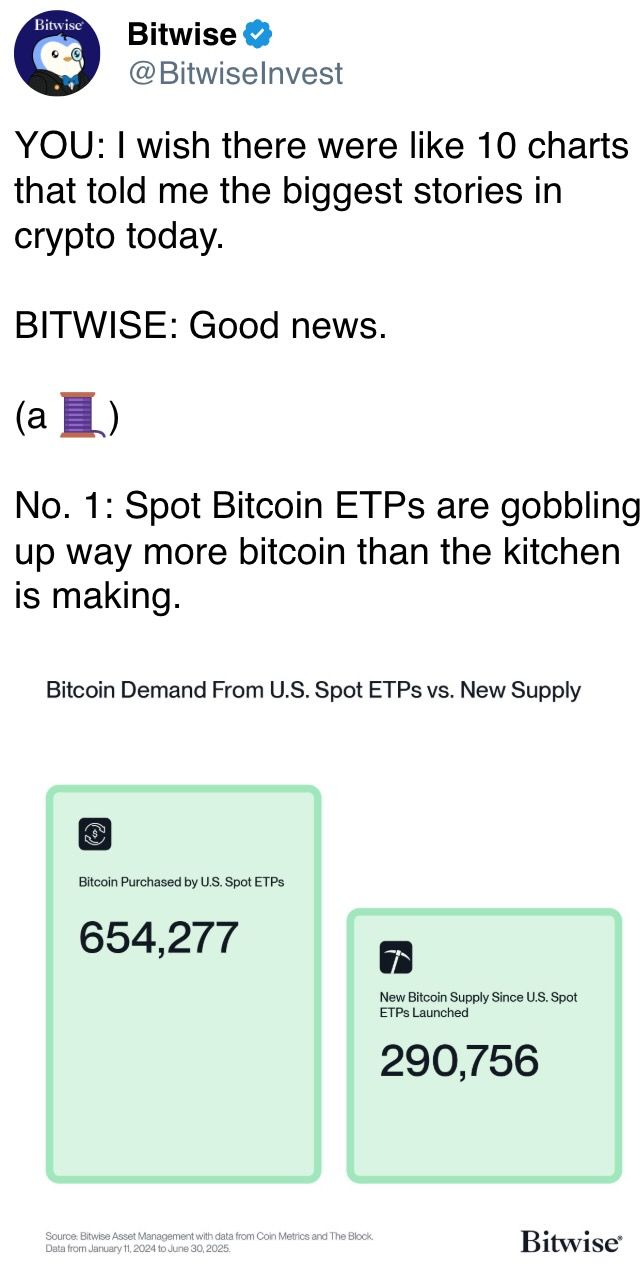
ETF inflows have become a central force in shaping bitcoin’s price action since the approval of U.S. spot products in January 2024. Citi estimates that these flows alone now account for over 40% of recent BTC price variation, giving them an outsized role in its new model.
While the adoption curve still serves as the anchor, the growing integration of crypto into traditional finance through the ETFs, index inclusion and greater regulatory acceptance, means macro and institutional flows are rising in importance, the report said.
Citi’s analysts note that the risk to their forecast is tilted to the upside. ETF demand has been accelerating faster than expected, and user activity shows a slower-than-modeled decay rate, suggesting that network effects may persist longer than initially projected.
Bitcoin’s trajectory now depends as much on capital allocation strategies and investor flows as it does on technological adoption, the report said.
Read more: Crypto Inflows Surge to $60B Year-to-Date, Outpacing Private Equity: JPMorgan
]]>OSL, which was the first exchange to win a license from the Hong Kong Monetary Authority (HKMA), said it will use the new capital to develop new business initiatives, such as building payment and stablecoin services.
Hong Kong will start allowing stablecoin issuance under a new regulatory regime taking effect at the start of August. It is in the process of unveiling a range of policies for the regulation of digital assets, establishing a framework to oversee exchanges and custodians for the purposes of risk management and investor protection.
It also plans to allow professional investors to trade derivatives.
OSL also plans to use the capital to support acquisition plans and bolster its balance sheet.
Read More: The Market Has Become 'Overly Excited' for Stablecoins, Hong Kong Financial Regulator Says
]]>Between July 17 and July 24, the wallet transferred 50 million XRP, worth approximately $175 million. Some $140 million of that was directed to centralized exchanges, according to blockchain analyst ZachXBT.
Transferring tokens to an exchange is widely interpreted as an intention to liquidate holdings for stablecoins or other tokens because large amounts are usually not stored on exchanges for a long time.
The transactions occurred shortly after XRP touched a record $3.64 before pulling back to around $3.
Neither Larsen nor Ripple has commented on the matter publicly.
“Wallets linked to Chris Larsen still hold over 2.81 billion XRP (worth $8.4 billion),” ZachXBT noted. That represents about 4.6% of XRP’s total market cap.
XRP is down over 14% in the past week, with the bulk of the losses coming from a liquidation cascade on Thursday that wiped out over $105 million in XRP long positions, the second-largest altcoin liquidation during a $735 million crypto market crash.
The liquidations came as XRP dropped as much as10%, testing support in the $3.06–$3.10 zone before price stabilized near $3.08.
Despite the price drop, traders and analysts are targeting the $6 mark in the medium term, as CoinDesk reported earlier this week.
]]>XRP posted sharp losses during the July 24–25 session, dropping 8% as the token traded in a $0.30 range from $2.96 to $3.26.
An early session rally fizzled after profit-taking intensified near the resistance level, while a sudden liquidation wave wiped out more than $100 million in long positions.
Despite the selloff, key support at $3.06–$3.10 held through repeated tests, with late-session price action showing signs of potential stabilization.
Nature’s Miracle and Brazil’s VERT made headlines with new XRP-based strategies, but institutional sellers dominated the tape amid fears that ETF approvals may face delays.
News Background
• XRP traded in a 7.85% range between $2.96 and $3.26 over 24 hours starting July 24 at 05:00.
• Coinglass data showed over $18 billion in total crypto liquidations during the session.
• XRP long liquidations topped $105 million, contributing to rapid declines.
• Nature’s Miracle announced a $20 million XRP treasury plan.
• Brazil-based VERT deployed a $130 million blockchain solution built on the XRP Ledger.
Price Action Summary
The session opened at $3.13 and saw a sharp drop to $2.96, followed by a bounce to a $3.26 high at 15:00 on 175.94 million volume — more than double the average. However, resistance at $3.24–$3.26 capped gains. Price collapsed again late in the session, dropping to $3.05 during the 03:00–04:00 window on a 6.2 million volume spike, likely due to forced selling or liquidation flows. XRP recovered modestly to close at $3.08.
Technical Analysis
• Trading range of $0.30 between $2.96 low and $3.26 high.
• Heavy resistance confirmed at $3.24–$3.26 after rejection post 15:00 rally.
• Critical support at $3.06–$3.10 tested repeatedly with volume-backed bounces.
• Final hour shows breakdown to $3.05 before reclaiming $3.08 — a possible bullish reversal signal.
• Liquidation-driven volatility suggests increased risk, but firm bid zones offer short-term structure.
What Traders Are Watching
• Whether XRP can hold the $3.06–$3.10 zone into the next session.
• Impact of further ETF-related developments from U.S. regulators.
• Signs of institutional reentry or renewed retail participation above $3.15.
• Broader crypto market stability following multi-billion-dollar liquidations.
The leading cryptocurrency by market value slipped over 2.5% to $115,170, hitting the lowest since July 10, according to CoinDesk. The move marked the downside break of the recent consolidation between $116,000 and $120,000.
The so-called range breakdown follows bearish hints from key technical indicators and has increased the possibility of prices revisiting the former resistance-turned-support at $111,956, the high clocked in May.
The broader cryptocurrency market wilted, with ether (ETH), Solana (SOL), and XRP (XRP) losing 2% to 3%. The CoinDesk 80 index, the broader market gauge, stood at 898 points at press time, representing a 2.6% drop on a 24-hour basis.
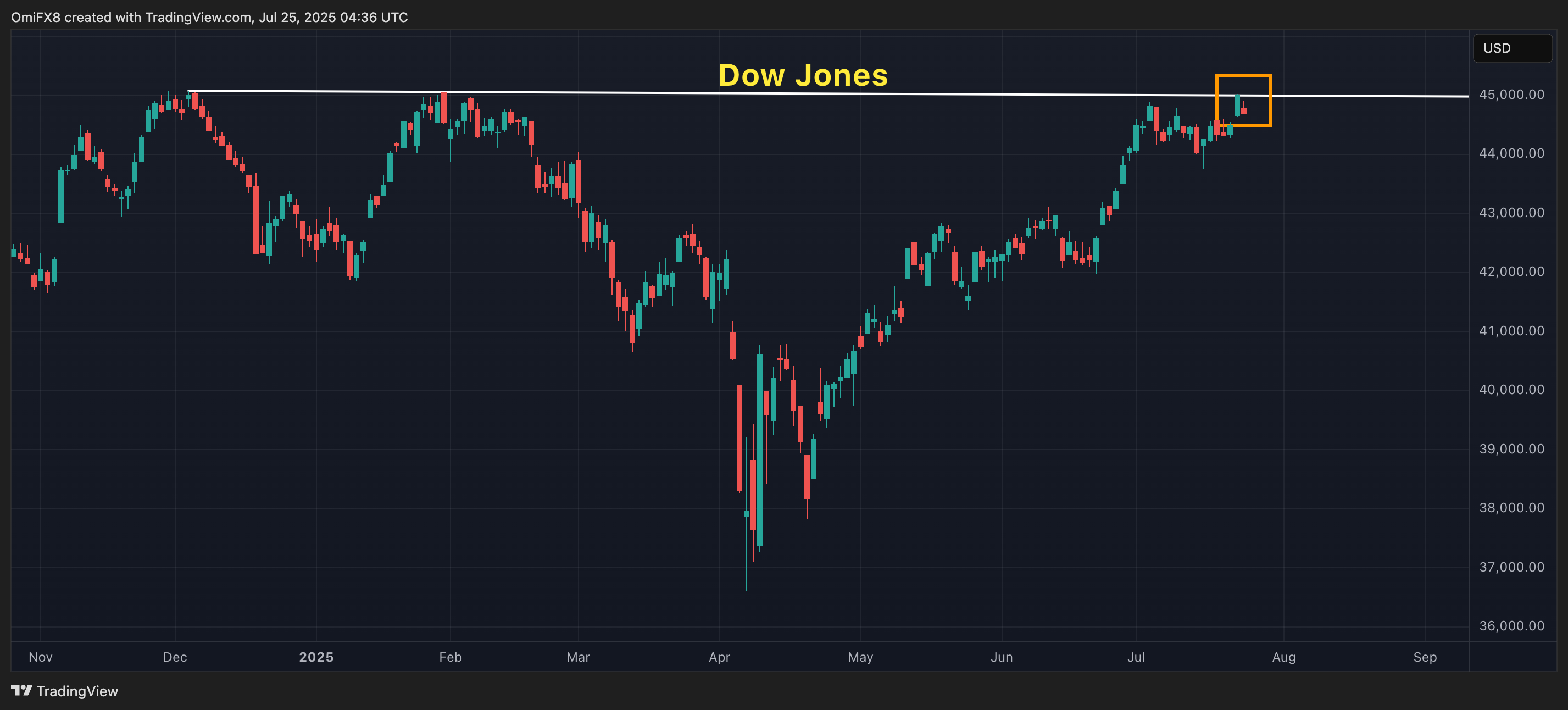
Overnight, Wall Street's Dow Jones index fell 0.70% in a sign that sellers were looking to re-establish their dominance at 45,000, the horizontal resistance identified by highs reached in December and January. A potential bearish reversal from here could sour sentiment in the crypto market.
 ]]>
]]>